
Path Lights vs. Uplights: What Your Landscape Needs as Days Get Shorter
23rd Sep 2026
Path Lights vs. Uplights: What Your Landscape Needs as Days Get Shorter
As fall arrives and daylight fades earlier, outdoor lighting becomes more noticeable and more useful. A well-planned system can help people move through the landscape after dark while also highlighting the features that make the property distinctive.
Two of the most useful fixture types are path lights and uplights and accent lights. Although both illuminate outdoor spaces, they perform different jobs. Understanding that difference makes it easier to decide where each fixture belongs and how they can work together.
What Path Lights Are Designed to Do
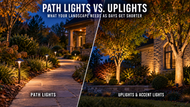
Path lights direct light downward and outward near ground level. Their primary purpose is to make routes through the landscape easier to see after dark.
They work especially well along walkways, garden paths, driveway edges and transitions between outdoor areas. They can also help define planting beds and landscape borders without overpowering the surrounding space.
Good path lighting should guide the eye naturally. Fixtures do not need to be placed in a rigid line or at identical intervals. Staggering them from side to side often creates a softer appearance and avoids making a walkway look like a runway.
Spacing depends on the fixture height, light output, beam pattern and the amount of ambient light already present. The goal is to provide useful pools of light without creating harsh glare or leaving distracting dark gaps.
What Uplights and Accent Lights Are Designed to Do
Uplights and accent lights are typically positioned near the ground and aimed upward or toward a specific feature. Instead of marking a route, they create depth, contrast and visual interest.
Common applications include illuminating mature trees, textured stone, columns, entryways, ornamental plantings and architectural details. A narrow beam can emphasize a tall or slender feature, while a wider beam can spread light across a wall, canopy or larger planting area.
Small adjustments make a meaningful difference. Moving a fixture closer to a surface can emphasize texture and shadow. Pulling it farther away creates a broader, more even wash. Changing the angle can determine whether the result feels dramatic, subtle or overly bright.
Path Lights vs. Uplights
The easiest way to separate the two is to think about function:
Path lights help people see where they are going.
Uplights help people notice what they are looking at.
If a dark walkway, driveway edge or garden path is the main concern, path lighting is the logical starting point. If the landscape disappears after sunset and needs more dimension, uplights and accent lights will have the greater visual impact.
For many homes, the best answer is not one or the other. It is a combination of both.
Why Layered Outdoor Lighting Works Better
A landscape illuminated with only one fixture type can feel flat or incomplete. Path lights alone may make the walkway visible while leaving the home and surrounding plantings in darkness. Uplights alone may create an attractive view but do little to define how people should move through the space.
Layering the two creates a more balanced result. Path lights establish the practical routes. Uplights add vertical interest and bring important features into view. The landscape feels connected rather than divided into isolated bright spots.
Additional fixtures such as deck and step lights, hardscape lights or in-ground lights can then be added where the property calls for them. The system should grow from the way the space is actually used, not from a desire to illuminate every surface.
Choose a Consistent Color Temperature
Color temperature affects how the entire installation feels. Warm white light, commonly around 2700K to 3000K, generally complements residential architecture, wood, stone and fall landscaping. Mixing noticeably different color temperatures can make an otherwise coordinated system feel disconnected.
Also pay attention to brightness and glare. More light is not always better. Fixtures should provide enough illumination for their intended purpose while keeping the light source comfortable to look toward.
Plan the Transformer and Controls
Low-voltage outdoor lighting also requires the right power and control equipment. Before selecting a transformer, total the wattage of the planned fixtures and allow appropriate capacity for the complete system. If additional fixtures may be added later, planning for some expansion can make future changes easier.
Transformers and controls can also provide scheduling or smart-control options, depending on the system. Automatic operation becomes especially useful in fall, when sunset arrives earlier and continues changing throughout the season.
Start With the Areas That Need Light Most
Walk the property after dark and identify the places where lighting would make the biggest difference. Start with frequently used paths, entrances, steps and transitions. Then look for one or two trees, architectural elements or planting areas that deserve emphasis.
This approach keeps the project focused and makes it easier to build the system in stages. You can establish the necessary routes first, add visual highlights second and expand the design as you see how the lighting performs at night.
Create a Landscape That Works After Dark
Path lights and uplights do not compete with each other. They solve different parts of the same outdoor-lighting challenge. Path lights provide guidance and definition near the ground, while uplights create height, depth and nighttime character.
As the days get shorter, it is an ideal time to look at the property after sunset and decide what needs to be seen. Lighting World Warehouse offers path lighting, uplights, transformers, controls and other components to help you design a complete outdoor lighting system for your landscape.